
|
Two taxonomic systems are used, modern cladistics and the older Linnaean system. In paleontology, the Linnaean system is rarely used (except for genus and species) - cladistics has proven more useful.
1. Cladistics is a method of classifying organisms by common ancestry, based on the branching of the evolutionary family tree. Organisms that share common ancestors (and therefore have similar features) are grouped into taxonomic groups called clades. Cladistics can also be used to predict properties of yet-to-be discovered organisms. Phylogenetic systematics is a method of classification based on the evolutionary history of organisms, dividing organisms into meaningful groups and subgroups. It was developed by Willi Hennig, an entomologist, in 1950, but was not well accepted until decades later.
Cladistics is based on three principles:

A cladogram is a branching diagram that depicts species divergence from common ancestors. They show the distribution and origins of shared characteristics. Cladograms are testable hypotheses of phylogenetic relationships. Dinosauria On-line has a huge cladogram of the dinosaur species, and "The Dinosaur Pages" has an index of dinosaur clades.
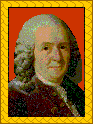 2. The Swedish scientist Carolus Linnaeus (1707-1778) developed the two-name (Genus and Species) system for identifying and classifying living things. The Linnaean System is based on a simple hierarchical structure in which organisms are sorted using the nomenclature of Kingdom, Phylum, Class, Order, Family, Genus and Species. Organisms belonging to the same kingdom are not necessarily very similar; organisms belonging to the same species are very similar and can produce offspring.
| TAXON* | STEGOSAURUS | HUMAN |
| Kingdom Phylum Class Order Family Genus Species |
Animalia Chordata Archosauria (in some systems, Reptilia) Ornithischia Stegosauridae Stegosaurus stenops |
Animalia Chordata Mammalia Primates Hominidae Homo sapiens |
Enchanted Learning®
Over 35,000 Web Pages
Sample Pages for Prospective Subscribers, or click below
|
Overview of Site What's New Enchanted Learning Home Monthly Activity Calendar Books to Print Site Index K-3 Crafts K-3 Themes Little Explorers Picture dictionary PreK/K Activities Rebus Rhymes Stories Writing Cloze Activities Essay Topics Newspaper Writing Activities Parts of Speech Fiction The Test of Time
|
Biology Animal Printouts Biology Label Printouts Biomes Birds Butterflies Dinosaurs Food Chain Human Anatomy Mammals Plants Rainforests Sharks Whales Physical Sciences: K-12 Astronomy The Earth Geology Hurricanes Landforms Oceans Tsunami Volcano |
Languages Dutch French German Italian Japanese (Romaji) Portuguese Spanish Swedish Geography/History Explorers Flags Geography Inventors US History Other Topics Art and Artists Calendars College Finder Crafts Graphic Organizers Label Me! Printouts Math Music Word Wheels |
Click to read our Privacy Policy
| Search the Enchanted Learning website for: |